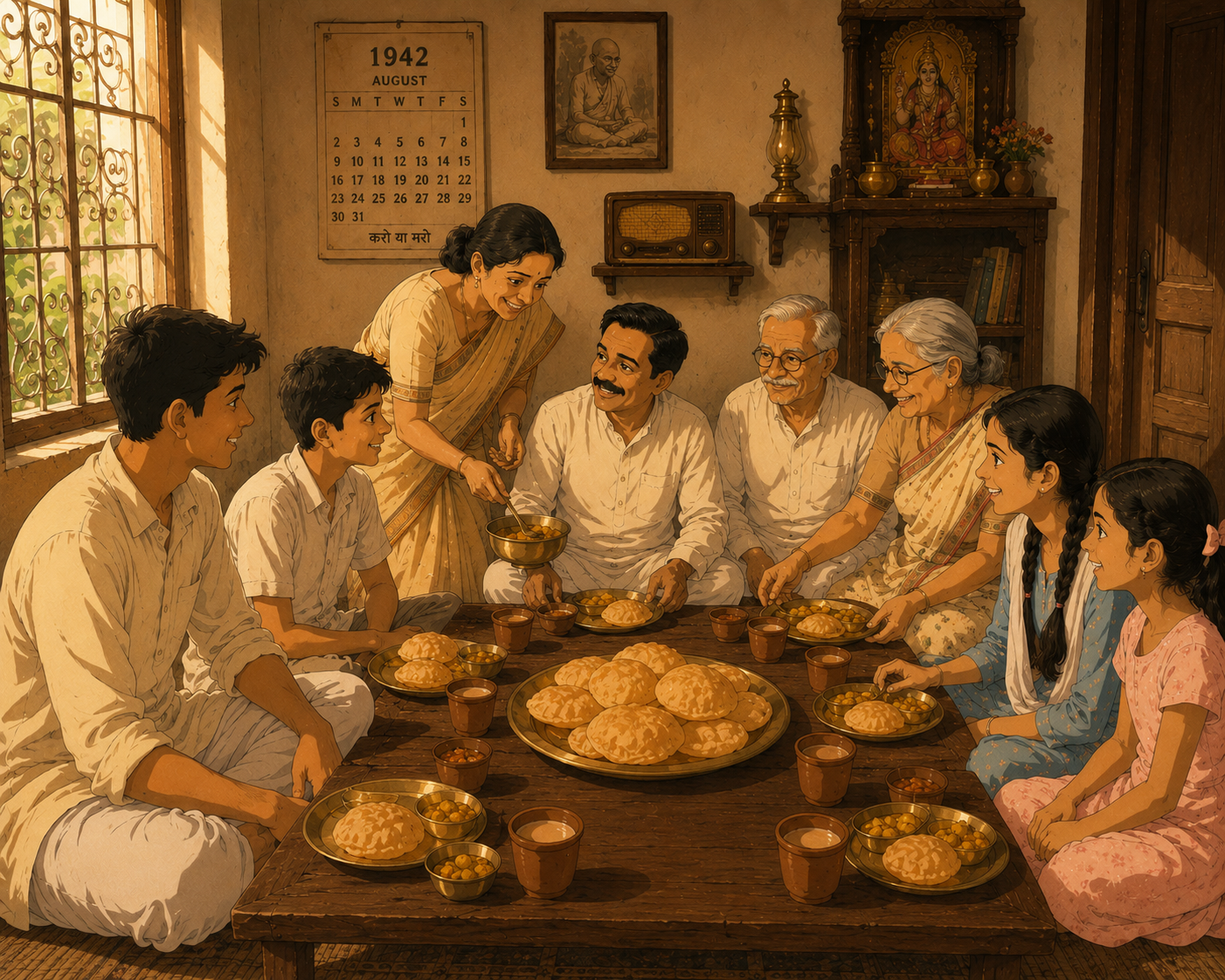

The monsoon came late to Allahabad that year, as though the sky too could not make up its mind. It was August 1942, and the whole of India seemed to be holding its breath. In the narrow lane of Tagore Gali, behind the post office and beside the old peepal tree, the Sharma household rose two storeys above the mud street. Its ochre walls stained by old rains, its iron grille windows always slightly open, always listening.
Shiv Prasad Sharma, Dada to everyone inside those walls, had sat on the same wicker chair on the terrace for forty years. He had watched sentiments of the people change over the last few years. That morning, he held a rolled newspaper without reading it, his white dhoti pressed sharp despite the heat, his spectacles fogged. He already knew what was in it. The British had arrested Gandhiji. Quit India had begun.
“The whole bazaar is shut,” Sundar called from the stairwell, breathless from running. At fourteen, he experienced every political moment as an athletic event, something to sprint toward. “Vikram bhaiya’s friends are marching to the collectorate!” Dada did not move. “And where is your bhaiya?” A silence filled the room below like water filling a vessel.
Vikram was, in fact, already gone. He had left before dawn, tucking a folded handwritten pamphlet “Angrezi Raj Murdabad” inside his kurta with the reverence of a prayer. At eighteen, he had the beautiful recklessness of those who have just discovered a cause larger than themselves. He believed in freedom the way young men believe in love: completely, and without calculating the cost.
Harishchandra discovered his son’s empty bed at six in the morning. He stood at the doorway for a long moment, then went downstairs and ate his breakfast without a word. He was a government clerk, a servant of the very administration his son now marched against. His paycheck bore the seal of the British Crown. His pension would, too. He was not a traitor to India. He was also not a man who could afford to be seen as one by the wrong people.
He was a man caught inside a country that was cracking down the middle, and his family lived on both sides of the fault line.
“A household is not a parliament,” Dadi often said. “We do not vote here. We eat together.”
It was Amma, Kamla, who held the house upright through that charged morning. She moved between rooms with her characteristic economy of motion: a cup of tea brought to Dada, a stern glance at Sundar to stop him from sneaking out, a shawl placed without comment on Dadi’s shoulders. She had no opinions she announced about British rule or independence. But she had counted the rice and lentils in the tin, calculated how many days they could last if the markets stayed closed, noted which neighbour had a son in the police and which one had a son in the Congress. Kamla’s politics were domestic, and they were precise.
Leela sat in the eastern room with her notebook. She was sixteen and the household’s most careful watcher. Where Vikram acted and Sundar ran and little Meena asked impossible questions, Leela wrote. She had been writing since she was nine; first poems about the river, then about Dadi’s hands, and now, in her cautious, slanting script, about the particular loneliness of loving a country that did not yet exist.
Today Bhaiya left for the march. Pitaji ate breakfast and said nothing. Amma made extra rotis. Dada read the same line in the newspaper seven times. Dadi sang a bhajan softly. Meena asked why freedom is something you have to fight for if it belongs to everyone already. No one had an answer for Meena. They rarely did.
By afternoon, news arrived in fragments. A constable had beaten students near the railway station. Three shops on Civil Lines had been looted, by whom, no one agreed. Vikram’s name was not yet among the arrested, but Harishchandra had heard it muttered in corridors at the district office, paired with words like agitator and instigator. He came home at four, earlier than usual, and sat beside his father on the terrace.
For a long time the two men said nothing. Below them, the lane was unusually empty. A dog slept in a patch of shade. Someone was frying something in a distant house, and the smell of mustard oil drifted up like a long lost memory.
“He is wrong to go,” Harishchandra finally said.
Shiv Prasad turned his fogged spectacles toward his son. “He is not wrong to want what he wants.”
“There is a difference between want and method.”
“Yes,” said Dada quietly. “You have always been careful about method.” He said it without cruelty. It landed anyway.
Harishchandra did not reply. He looked out over the rooftops, terra cotta tiles, water tanks, a single kite tangled in a wire and felt, not for the first time, the exhausting weight of being a moderate man in an immoderate age.
Vikram returned just after sunset, unhurt but vibrating with an energy the house had never quite contained before. His kurta was dusty, his left palm scraped from where he had steadied himself against a wall as the lathi charge broke the march apart. He stood in the doorway and met his father’s eyes.
The household gathered without being summoned. This was the Sharma way. Dadi appeared from the kitchen. Leela stood in the corridor. Sundar pressed himself against the wall. Meena, who was supposed to be asleep, was very plainly not asleep.
Amma was the one who moved first. She crossed the room, took Vikram’s scraped palm in both hands, examined it, then went to get the tin of turmeric and cotton. She did not speak. She did not need to. The act itself said everything she wished to say: I am furious with you. I am grateful you are alive. Both things are true. Sit down.
The confrontation between father and son that the house half-expected did not come that night. Instead, Shiv Prasad asked Vikram to sit beside him and describe what he had seen. Vikram spoke haltingly at first, then with feeling. The women in white blocking the road, the students linking arms and singing Vande Mataram, the moment the horses appeared and the crowd held its ground for one long, terrifying, magnificent second before scattering.
Harishchandra listened from the doorway. His face gave nothing away.
Later, when the younger children were finally asleep and Dadi had gone to her room murmuring prayers, Leela found her father on the terrace alone. She brought him a glass of water and sat cross-legged beside his chair, as she had done since she was small.
“Pitaji,” she said carefully. “Do you want India to be free?”
He was quiet for a moment. Then: “I want your brother to live to be old. I want Sundar to finish school. I want your Dada’s pension to clear. I want your Amma to sleep without worry.” He paused. “And yes. Yes, I want India to be free.”
“Then you and Bhaiya want the same thing.”
“We want the same destination,” he said. “We disagree on which road to take.” He looked at her then. “Write that down, Leela. Disagreement inside a family is not the same as disloyalty to it.”
The monsoon finally broke that night – a genuine, soaking, merciful rain. The whole city exhaled. By morning, the markets had cautiously reopened. The arrested students were processed and, mostly, released. The march had not changed the law, but it had shifted something in the air of the city, something small and irreversible, the way a single stone moved in a riverbed changes the current invisibly for miles downstream.
The Sharma family ate breakfast together, all eight of them, which was unusual for a weekday. Dadi made puris because the oil had been rationed and she wanted to use it before it went stale but also, Leela thought, because puris were a celebration disguised as practicality, which was Dadi’s exact idiom. Meena ate four and asked whether Gandhi would be coming to Allahabad once he was released, and whether they could go see him, and whether freedom would mean there would be more sugar for sweets.
“More of everything,” Dada told her gravely. “That is the idea.”
Vikram caught his father’s eye across the table. Harishchandra gave the smallest, most controlled nod a man could give; barely a movement at all, really. But Vikram saw it, and Leela saw Vikram see it, and she wrote it down later, in her careful slanting hand, in the notebook she would keep for fifty more years.
We are eight people who do not always agree. But we pass the food. We treat each other’s wounds. We eat together in the morning. Perhaps this is also a kind of independence; the small, daily, unchosen kind. Perhaps this is where the other one begins.
This post is a part of Fam Jam Blog Hop hosted by Manali Desai and Sukaina Majeed under #EveryConversationMatters blog hop series.


Leave a Reply