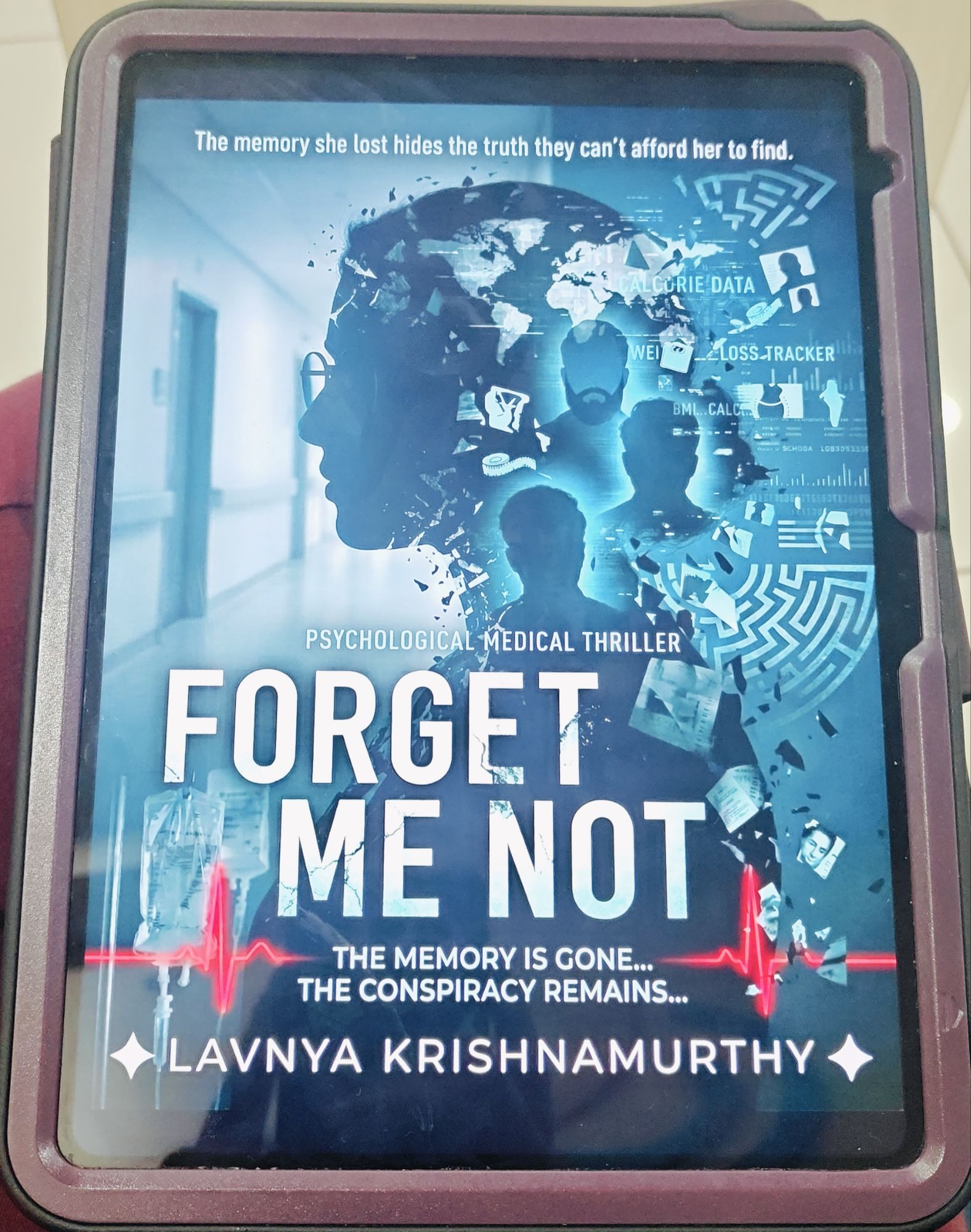

Forget Me Not by Lavnya Krishnamurthy starts with Avanthika waking up in a hospital bed to a room full of people who know more about her than she does. Retrograde amnesia, the doctor tells her. A phrase that arrives with the clean clinical weight of a diagnosis and none of the comfort of an explanation. Everything before the accident has been wiped. What is left is a woman with a name she must take on trust and a life she has to rebuild out of other people’s testimony.
I spent thirteen years in banking learning to be wary of exactly that kind of file. When the documents are missing, you do not simply accept what you are told. You look for corroboration, you look for the gaps, and above all you notice who benefits from the gaps staying where they are. Avanthika’s situation is a compliance officer’s nightmare rendered as fiction: an identity with no supporting evidence, reconstructed entirely from the declarations of interested parties.
And the parties are interested. There is Marvin, the best friend, warm and steady. There is Dr Shankar, the ex-boyfriend, professionally close and personally complicated. And there is Ravi, the estranged husband, who wants very much to come back. A man whose eagerness to get back to her good books is itself a data point worth flagging. Krishnamurthy is clever about this. She lets each of them hand Avanthika a version of her past, and leaves the reconciliation to us.
The best thread in the book runs alongside all of this and only slowly turns towards it. Young girls keep arriving at the hospital for emergency appendectomies. Not one, not two. Enough that Dr Shankar cannot stop turning the numbers over. Anyone who has watched a monitoring alert light up will recognise the feeling exactly: nothing in any single case is wrong, and yet the pattern is unmistakably wrong. Appendicitis is common. This many, in this window, in this demographic, is not. It is the quiet horror of a cluster, and it is the point at which the novel stops being a mystery about one woman and becomes something colder.
Krishnamurthy is an ophthalmologist by profession, and it shows in the best way; the hospital is never scenery. She knows how a ward actually runs, how a doctor’s unease surfaces first as a filing habit rather than a speech, and that authority lends the whole premise a weight it would not otherwise carry.
Avanthika’s own investigation runs on the same instinct. She was a journalist before the accident, and the profession seems to have survived the injury even where the memory did not. She asks. She keeps asking. Watching her recover a self through the practice of her work, rather than through some tidy flood of returning images, is the most convincing thing in the book.
The suspense is genuinely well handled. I guessed, and revised, and guessed again, and I still was not where I expected to be at the end. Krishnamurthy withholds cleanly and pays off cleanly, which is harder than it looks and rarer than it should be.
My one real reservation is a matter of proportion. This is a novel that rests a great deal of weight on a woman’s mind – memory loss, body image, the particular vertigo of being unable to verify your own life – and depression sits underneath all of it, acknowledged but never quite given room. It is touched, and then moved past. Given how much the plot turns on young women in distress, I wanted the book to sit there longer than it does. The thriller machinery is so well built that the interior weather gets a little crowded out.
Still an interesting, well-paced story with a genuinely unsettling idea at its centre, and a heroine who investigates her way back to herself. Worth reading.
My rating: 4/5.
This review is powered by the Blogchatter Book Review Program.
Leave a Reply